

Forming Machine
High Quality Products
The company has strict standards and processes in product quality control to ensure that every piece of equipment leaving the factory meets high standards and requirements. This insistence on product quality can win the trust and praise of customers and establish a good market reputation.
Technological Innovation and R&d Strength
The company has a strong technical research and development team and innovation ability, and can continuously launch intelligent equipment products that meet market demand and leading technology. This continuous technological innovation is a key factor in promoting the development and competitiveness of the company.
Customized Solutions
With the continuous development of the manufacturing industry, enterprises' demand for intelligent equipment tends to be more and more personalized and customized. The company has the ability to provide customized solutions according to customer needs, to meet the specific needs of different enterprises, and to improve production efficiency and product quality.
Perfect After-Sales Service System
Good after-sales service is an important guarantee for enterprises to establish long-term cooperative relationship with customers. The company has a perfect after-sales service system, including professional technical support team, rapid response mechanism and attentive customer service, to ensure that customers get timely and effective help and support in the process of use.
-
 Mixers Intelligent Production LineOur Xiangneng Company's Mixers intelligent production line employs a clear modular architecture, specifically divided into five independent functional units: a mixer truck production line, aAdd to Inquiry
 -
 Dished Head Spinning MachineThe core advantage of the Dished head spinning machine stems from its deep alignment with the essential needs of industrial production, with its reliability built upon a scientifically designed basicAdd to Inquiry
 -
 Tank Production LineThe Tank Production Line is adaptable to the manufacturing needs of storage tanks of various materials and specifications, covering commonly used tank materials such as stainless steel and carbonAdd to Inquiry
 -
 Hydraulic Dished Head Configuring MachineThe rigid frame of the hydraulic dished head configuring machine is constructed from high-quality steel and features a box-type structure design. This structure effectively suppresses machineAdd to Inquiry
 -
 Chain Type Turnover MachineChain Type Turnover Machine This Chain-Type Turnover Machine employs a double-chain drive structure. The transmission components are made of high-strength alloy material and undergo precisionAdd to Inquiry
 -
 Long Shaft Turning RollLong Shaft Turning Roll Our Long Shaft Turning Roller is designed with "universal adaptability" as its core principle. It can accommodate the machining needs of long shaft workpieces ofAdd to Inquiry
 -
 Tire Changing MachinesThis tire changing machine is suitable for tire installation and removal for a wide range of vehicle types, including sedans, SUVs, and light trucks. It accommodates various tire sizes and types,Add to Inquiry
 -
 Long Axis Roller FrameThe Long axis roller frame is a device that uses the friction between the weldment and the active roller to drive the circular weldment to rotate in order to complete the welding of the annular weld.Add to Inquiry
 -
 Vacuum Forming MachineVacuum forming machine, often called blister forming, is a plastic processing technology. The main principle is to heat and soften the flat plastic hard sheet, then use vacuum adsorption to the moldAdd to Inquiry
 -
 Corrugated Board Automatic Forming MachineThe corrugated cardboard forming production line is a set of corrugated cardboard forming production line solutions designed based on the customer's production requirements and the company'sAdd to Inquiry
 -
 CNC Semi-trailer Corrugated Board Forming MachineThe CNC corrugated board forming production line is a set of corrugated board forming production line solutions designed based on the customer's production requirements and the company's long-termAdd to Inquiry
 -
 H-type Girder Assembly ToolingThis equipment is suitable for the assembly and welding of longitudinal beams, main cross beams, traction plates, suspensions and aileron plates of ordinary straight beam semi-trailers and ordinaryAdd to Inquiry


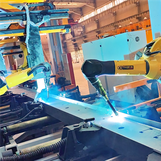

Gear box driven forming machine
The workhorses of the metalworking industry, gear-driven forming machines shape and mould metal sheets and other materials into a wide range of components and products. They provide a strong and accurate high-volume manufacturing solution that can handle a variety of materials and thicknesses.
① How gear box driven forming machines work
A gearbox is the central component of a gear-driven forming machine, transferring power from an electric motor to the forming tools. Accurate and consistent outcomes are ensured by the gearbox's ability to precisely manage the forming process's torque and speed. To produce the required forms and profiles, there are several configuration options for the forming tools themselves.
② Types of gear box driven forming machines
Presses: Presses are the most common type of gear-driven forming machine. They use a ram and die to apply pressure to the material, forming it into the desired shape.
Roll forming machines: Roll forming machines use a series of rollers to continuously form the material into the desired shape. They are ideal for creating long, straight parts.
Bending machines: Bending machines use a punch and die to bend the material along a desired axis.
Shearing machines: Shearing machines use a blade to cut the material to the desired size and shape. They are often used in conjunction with other forming machines.
Chain driven forming machine
Chain-driven forming machines transfer power from an electric motor to the forming tools via a chain rather than a gearbox. Compared to a gearbox, a chain offers a greater range of speeds and power, making it more adaptable to various forming applications.
① Applications of chain driven forming machines
Chain-driven forming machines are an excellent choice for a variety of applications, including:
• Low-volume production: Chain-driven forming machines are ideal for low-volume production runs, as they are less expensive to purchase and operate than gear-driven forming machines.
• Prototype development: Chain-driven forming machines are often used for prototype development, as they allow for quick and easy changes to the forming tools.
• Short-run production: Chain-driven forming machines can be used for short-run production runs, as they can be set up and running quickly.
• Repair and maintenance: Chain-driven forming machines are often used for repair and maintenance tasks, as they are portable and easy to use.
② Types of chain driven forming machines
Chain-driven forming machines are used for many of the same applications as gear-driven forming machines, including:
• Presses: Chain-driven presses are used to form a variety of parts, such as automotive components, appliance parts, and construction materials.
• Roll forming machines: Chain-driven roll forming machines are used to create long, straight parts, such as pipes, channels, and beams.
• Bending machines: Chain-driven bending machines are used to bend sheet metal and other materials along a desired axis.
• Shearing machines: Chain-driven shearing machines are used to cut sheet metal and other materials to the desired size and shape.
Chain driven forming machine
Many different industries use forming machines, including:
• Automotive: Body panels, chassis pieces, and engine parts are just a few of the items that are made by forming machines for vehicles and trucks.
• Aerospace: Parts for aeroplanes, spacecraft, and missiles are made using forming machines.
• Medical: Syringes, catheters, implants, and other medical equipment are made with forming machines.
• Electronics: Circuit boards and connections, among other electronic components, are made using forming machines.
• Construction: A wide range of construction materials, including beams, pipes, and panels, are produced using forming machines.
Principle of Operation of the Forming Machines
Pressure transfer process
A forming machines is a device that processes plastics into parts or products by means of high pressure and high temperature. In this, pressure transfer is the first step in the working of the forming machines. It uses a screw to feed plastic pellets or powder into a heater, which melts it and creates a certain pressure.
Plastic melting process
In the heater, an external heater provides heat energy in the form of gas or electricity to further heat up the plastic and thus melt it. The molecular chains will also interlock with each other to form a fluid-like state.
Injection process
When the plastic reaches a certain temperature, it is injected into the mold through a pressure transfer system. This is the third step in the work of the forming machines. During the injection process, the processing pressure is often in excess of 100 MPa, which greatly improves the flow and filling properties of the plastic.
Cooling process
Once the plastic enters the mold in a specific shape, the cooling process begins. Cooling is the final step in the work of the forming machines and the most critical step in the manufacturing process. Cooling systems usually use water for cooling to prevent the plastic from distorting or shrinking inside the mold.
The Steps of Using a Forming Machines Are Explained in Detail
1. Preparation
• Confirm the required materials: Before using the forming machines, you need to prepare the required raw materials, molds and necessary auxiliary tools. Select the materials according to the requirements of the products to be made and choose the appropriate molds according to the size of the molds.
• Check the machine: Before using the forming machines, the machine should be checked to ensure that the machine operates normally and has no faults, wear and tear or loose phenomena to ensure the safety and stability of the machine.
2. Machine operation
• Installation of molds: Install the required molds on the table of the forming machines, pay attention to the direction and position of the molds.
• Adjust the parameters: According to the requirements of the molded products, adjust the parameters of the forming machines, including temperature, pressure, speed and other parameters to ensure the quality of the molded products and production efficiency.
• Start the machine: Start the machine correctly according to the machine's operating instructions and make adjustments to ensure that the machine operates normally.
• Start Molding: Put the required raw materials into the mold and start the forming machines for molding. Pay attention to check the quality and shape of the molded products during the process and adjust the parameters when necessary.
3. Maintenance
• Cleaning: Clean the surface of the machine and the mold after each day's work to prevent impurities from affecting the quality of the molded products and the life of the machine.
• Regular maintenance: Lubricate and overhaul the friction parts and lubrication parts of the machine to keep the normal operation and stability of the machine.
• Attention to safety: When using the forming machines, strictly follow the operating instructions, operating procedures and safety regulations to ensure the personal safety of the operator and the safe operation of the machine.

Precautions for Forming Machiness
Before operating the machine, you should refer to the machine operation manual to understand the basic principles and operating procedures of the machine.
When operating the equipment, wear personal protective equipment, including safety helmet, protective glasses, protective gloves and so on.
Pay attention to the operating status of the equipment during operation to avoid dangerous situations.
During processing, the status of equipment and processed parts should be checked regularly to ensure processing quality.
If abnormal conditions of the equipment are found, it should be stopped in time for maintenance and reported to the relevant person in charge.
During the operation of the equipment, the working surface should be kept neat and clean to avoid debris affecting the processing quality.
Processing is completed, clean up the equipment in a timely manner, to maintain the health of the equipment and a good working environment.
No unauthorized changes in the operating parameters of the equipment, such as the need to adjust should be approved by the relevant person in charge.
In the maintenance and repair of equipment, should first cut off the power supply, and in accordance with the equipment maintenance procedures for operation.
Common Forming Machines Troubles and Solutions
Common faults and solutions of forming machiness include but are not limited to the following:
Mold clamping unit failure: Can not lock the mold may be due to the front and rear safety doors are not closed, the robot is not returned, etc.; clamping may be too slow because of the clamping process pressure, flow set improperly; can not be tightly closed may be because of the clamping of the mold high pressure point has not yet been established or there are foreign objects in the mold; can not be opened may be due to the opening of the mold pressure and speed is set too low or the opening of the mold solenoid valve is not in action.
Injection unit failure: Can not shoot the seat into the mold may be because it has not been completely closed or the seat into the solenoid valve does not operate; discharge arc problems may need to check the high power board for damage; servo motors, the head can not be up and down, you should check whether the operation is correct, the servo cabinet servo drag version and limit switches are not damaged.
Heating and pressure system failure: Slow heating or unstable temperature may be due to heater failure or temperature sensor damage; unstable pressure may be due to hydraulic cylinder leakage or oil pump failure; these problems need to be solved by checking and repairing or replacing the faulty parts.
Control system failure: Control parameters can not be adjusted or the display is abnormal may be due to controller or sensor failure; should check the status of these parts and make the necessary repairs.
Structure of the Forming Machines
Pressure system
Pressure system mainly includes the press and the hydraulic system of the press. The press is one of the most important components of the forming machines and is used to apply high pressure to the raw material to deform it into a finished product. The hydraulic system is mainly responsible for providing pressure and power source for the press.
Transmission system
The transmission system mainly consists of gearbox, clutch and connecting rod, etc. It transfers the rotating power of the motor to the press through transmission force to realize the deformation of raw materials.
Heating system
The heating system is mainly used to heat the raw materials with poor plasticity, so as to make them have good plasticity and fluidity under a certain temperature and provide better molding conditions for the pressure system. The heating system includes electric heating system and liquid conduction heating system.
Mold
Mold is a general term for the processing molds used by the forming machines according to the requirements of the product, and its types and forms vary according to different products. Mold generally consists of upper and lower molds, which play a vital role in the molding process.
Control system
The control system is an important part of the forming machines, mainly used to automatically control the operation of the forming machines and the quality of the finished product. The control system consists of software and hardware, which can be set and adjusted according to the user's needs.
The Role of the Forming Machines
Molding machine is a widely used in industrial production equipment, its role is mainly reflected in the following aspects:
Automated production: The forming machines can automatically complete the process of opening, forming, lower bottom leaf folding and bending and lower part of the tape pasting, which greatly improves the production efficiency and reduces the labor cost. For example, automatic carton forming machines and automatic box opener plays an important role in the production of cartons, the realization of the automatic opening of cartons, folding the lower cover and sealing the lower bottom of the tape assembly line operations.
Plastic processing: In the plastic processing industry, forming machiness are used to manufacture a variety of plastic products. The development of plastic molding and processing equipment, from injection molding to extrusion molding, and then blow molding, are indispensable processing methods in industrial production.
Vibration compaction: Vibration forming machines uses the eccentric vibrator on the rotating shaft under the vibration platform as the vibration source to vibrate the material in the mold on the platform, effectively reducing the friction between each other inside the material to achieve the rearrangement of the material and the desired effect.
Precision Molding: Zhejiang Precision Vacuum Hot Press Forming Machines provides high-precision heating and pressure control during the product molding process to ensure that the product meets the precise size and shape requirements. Meanwhile, the application of vacuum environment excludes air and impurities in the molding process, improving product quality and surface finish.
Injection molding: Injection forming machiness are divided into various types according to the different plasticizing and transmission methods, such as horizontal injection forming machiness, vertical injection forming machiness and angle injection forming machiness. These injection forming machiness are widely used in the production of plastic products, with high efficiency, high precision and can be automated.
Water conservancy project construction: The aqueduct forming machines is used in water conservancy project construction to ensure the smoothness and stability of aqueducts through the suppression and trimming of soil. It improves the construction efficiency, construction quality and construction safety, and reduces the construction cost.
Widely used: The application of the forming machines is not only limited to the above fields, but also includes 3C industry, home appliance industry, electronic industry, automobile industry, etc. It is used to manufacture all kinds of decorative panels, shells of electronic products and so on.
Our Factory
Shandong Xiangneng Intelligent Equipment Technology Co., Ltd. is located in Yuncheng County, the world-famous hometown of Water Margin, with superior location and convenient transportation. The company was established in October 2018, covering an area of 30,000 square meters and a construction area of 15,000 square meters. The company has more than 100 employees, including 35 engineering and technical personnel, with total assets of 90 million yuan (RMB) and an annual production capacity of about 200 million yuan.
In order to accelerate the development of Industry 4.0 intelligent manufacturing, many parties have introduced high-end technical talents with high salaries, strengthened the integration of digital information technology and equipment manufacturing, and basically formed a technological innovation mechanism that focuses on simultaneous development of software and hardware and system integration. It has successively established cooperative relationships with the Institute of Automation of the Chinese Academy of Sciences, Shandong Qilu University of Technology (Shandong Academy of Sciences), Shandong University, and Shandong Jianzhu University, and established joint laboratories.

FAQ
We're well-known as one of the leading forming machine manufacturers in China. We warmly welcome you to wholesale customized forming machine at low price from our factory. For cheap products and free sample, contact us now.
intelligent metal cnc equipment, cnc container side panel pressing machine, advanced intelligent metal simulation equipment