

Plate Rolling Machine
High Quality Products
The company has strict standards and processes in product quality control to ensure that every piece of equipment leaving the factory meets high standards and requirements. This insistence on product quality can win the trust and praise of customers and establish a good market reputation.
Technological Innovation and R&d Strength
The company has a strong technical research and development team and innovation ability, and can continuously launch intelligent equipment products that meet market demand and leading technology. This continuous technological innovation is a key factor in promoting the development and competitiveness of the company.
Customized Solutions
With the continuous development of the manufacturing industry, enterprises' demand for intelligent equipment tends to be more and more personalized and customized. The company has the ability to provide customized solutions according to customer needs, to meet the specific needs of different enterprises, and to improve production efficiency and product quality.
Perfect After-Sales Service System
Good after-sales service is an important guarantee for enterprises to establish long-term cooperative relationship with customers. The company has a perfect after-sales service system, including professional technical support team, rapid response mechanism and attentive customer service, to ensure that customers get timely and effective help and support in the process of use.
-
 Stainless Steel Plate Rolling MachineStainless steel plate rolling machine is widely used in the steel industry. Steel mills use plate rolling machines to roll up hot-rolled steel coils, and then cut, straighten, rewind and otherAdd to Inquiry
 -
 Tank Shaped Roller StandThe tank shaped roller stand frame is a special welding auxiliary machine suitable for welding cylindrical and rectangular workpieces such as pipes, containers, and oil tanks. It is widely used inAdd to Inquiry
 -
 Tank Roller RackStructural features of tank roller rack 1. It can be combined arbitrarily according to the weight and length of the weldment, which is convenient and flexible to use; 2. The center distance of theAdd to Inquiry
 -
 Automatic Panel MachineThe automatic panelizing machine has the following characteristics: 1. High splicing precision: The automatic panel machine adopts a high-precision CNC system, which can accurately control theAdd to Inquiry
 -
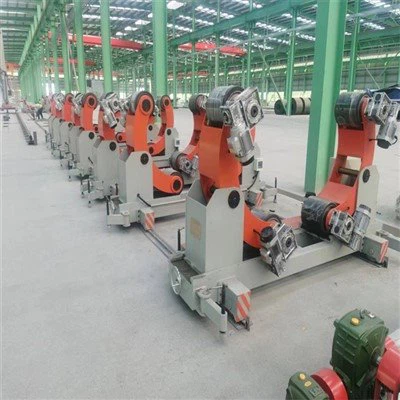 8 Power Roller RackThe 8 Power roller rack is a transmission device commonly used in the fields of material transportation, storage, production and processing. It can transport goods along the track, and has theAdd to Inquiry
 -
Power Roller RackThe use of Power roller rack is wide and diverse, and it plays an important role in many fields. Its main function is to facilitate the movement of various items by driving rollers with motors,Add to Inquiry
-
 Roller Frame Long AxisStructural features of roller frame long axis 1. It can be combined arbitrarily according to the weight and length of the weldment, which is convenient and flexible to use; 2. The center distance ofAdd to Inquiry
 -
 Manhole Flanging MachineCharacteristics of Manhole flanging machine 1. The flanging machine adopts advanced electronic control technology, with simple operation and high automation level. 2. The flanging machine hasAdd to Inquiry
 -
 Tank Truck Flood Control Plate Manhole Flanging MachineTank truck flood control plate manhole flanging machine tank trucks are widely used in various fields. On the upper part of the tank truck, there is usually a device called a manhole door. TheAdd to Inquiry
 -
 Special Shaped Roller RackSpecial-shaped roller frame operation process 1. Before operation, check whether all parts of the lathe are intact. Only after confirmation can the machine be started for operation. 2. During theAdd to Inquiry
 -
 Hydraulic Plate Rolling MachineTipping frame using hydraulic tipping; Vertical displacement of upper roller adopts hydraulic transmission, horizontal movement adopts mechanical transmission. The equipment has high reliability,Add to Inquiry
 -
Automatic Plate Rolling MachineThe automatic plate rolling machine of the plate rolling machine is mainly composed of a sheet material trolley, an actuator, a sheet material transmission mechanism and an auxiliary mechanism. TheAdd to Inquiry



What is Plate Rolling Machine
A plate roll machine is a piece of equipment that is used to roll various types of sheet metal into round, semi round, round with varying radii or conical shapes (some machines specialize in rolling materials back to flat too!). The rolling machine boasts a working mechanism that allows it to bend flat sheet metal into a large arc or cylinder or even a square, an ellipse shape and a multi-section arc. Utilizing a series of precise and strong hardened rolls powered by either hydraulic or mechanical methods, the rolls are brought into a pitching position with the material desired to be shaped. Once the material is firmly held between two of the rolls, a third and sometimes fourth roll is brought into position pushing the material causing the initial bend, or what is referred to as the pre-bend. The rolls then begin to rotate pulling material through the pinched rolls and past the pushing rolls forcing an arc into the material.
Benefits of Plate Rolling Machines for Your Business
Plate and sheet metal cone rolling machine models offer a lot of advantages for your business including efficiency, precision, increased output, and easy operation.
Efficiency
While some steel sheet rolling machine options are more efficient than others, these machines can help you boost productivity. That means more work gets done and you have the capacity for higher revenue.
Precision
Plate rolling machines are very precise and the accuracy can mean happier clientele no matter what industry you’re in. That’s why they are used in industries where accuracy is critical like aerospace or construction.
High output
Connected with efficiency is the benefit of high-volume output. This is especially true of 4-roll steel plate bending machines, but any of these options both hydraulic and electric can help you increase output compared to manual bending processes.
Simplicity
Plate rolling machines are easy to use, safe, and effective. While some training is required, they are easier to use than many of the alternatives, especially models that pinch both sides because that means your team will not have to weld, and if they do the welding will be minimal.
Classification of Plate Rolling Machines
- Three-roll initial-pinch or single initial-pinch plate rolls generally are for light-capacity applications and may be electromechanical or hydraulic. They work by pinching the flat sheet between two vertically opposed rolls while the third, offset roll—or bending roll—moves upward to contact and then bend the sheet. When rotation of the rollers is activated, the sheet exits at a given radius. With the sheet cut to the developed length and the bending roll properly positioned, the part is rolled into a cylindrical shape that can then be welded at the seam to produce a closed cylinder.
- When a cylinder is completely rolled, it is extracted from the top roll. Machines generally are equipped with some type of top roll release mechanism that allows for the cylinder’s extraction. This extraction is accomplished with the help of a forward-tilting or forward-releasing top roll or a removable end yoke.
- In most applications, these machines require removal and reinsertion of the sheet to prebend both ends. They are cost-effective but may be more labor-intensive in a production setting than their modern counterparts.
Double-pinch plate rolls are available in light to very heavy capacities and can have three or four rolls. The terminology can be confusing as these units also may be referred to as double-pinch pyramid plate rolls or double-initial-pinch plate rolls. Both three- and four-roll styles have fixed-position top rolls and two offset, or lateral, rolls, one on each side.
The four-roll styles have an additional roller underneath the top roll, which constantly pinches the plate during rolling. Double-pinch rolls can pre-bend both plate ends without removal, as is required with single-pinch rolls.
- Three-roll machines generally require pre-bending the leading end, running the sheet through the machine to prebend the trailing end, and then switching roll rotation direction to roll the cylinder body. Four-roll plate rolls have a slight advantage in cycle time because they permit pre-bending of the leading edge, rolling the cylinder body, and finishing off the trailing prebend, all while rolling in the same direction.
- Two-roll machines are designed for thin-gauge material rolled to reasonably small diameters. They use a large-diameter, urethane-coated pinch roller that moves up with extreme pressure against a small-diameter steel top roll. A mandrel or drum, very close in OD to the desired ID of the finished part, is fitted over the top roll.
- Two-roll sheet rolls are extremely fast and will roll round parts even if the blank has cutouts or holes. Because they require a mandrel for each part diameter and material thickness, they are not as versatile as some other machines, but for dedicated high-speed production, they are often the absolute best choice.
The upper roller of the symmetrical plate rolling machine is at the symmetrical position of the two lower rollers through the hydraulic oil in the hydraulic cylinder to act on the piston for vertical lifting movement, and the final gear of the main reducer drives the gears of the two lower rollers to mesh for rotating motion, which is the rolling motion Provide torque. The flat plastic metal plate of the plate rolling machine passes between the three working rolls of the plate rolling machine. With the help of the pressing of the upper roller and the rotation of the lower roller, the metal plate is continuously bent through multiple passes, resulting in permanent plastic deformation. Roll into the required cylinder, cone, or part of them. The disadvantage of this hydraulic three-roller bending machine is that the end of the plate needs to be pre-bent with the help of other equipment. This rolling machine is suitable for large rolling machines with a thickness of more than 50mm. A row of fixed idlers is added under the two lower rollers to shorten the span of the two lower rollers, thereby improving the precision of the rolled workpiece and the overall performance of the machine.
● The movement form of the plate rolling machine
The movement form of the plate rolling machine can be divided into two forms of main movement and auxiliary movement. The main motion refers to the movement of the upper and lower rollers constituting the plate rolling machine to rotate and bend the processed plate, and the main motion completes the processing tasks of the plate rolling machine. Auxiliary movement is the form of movement of the loading, unloading and lifting of the upper roller, the lifting and the turning of the headstock during the rolling process of the plate bending machine.
The mechanism is a three-roller symmetrical type. The upper roll is vertically moved at the symmetrical position of the two lower rolls. It is obtained by the screw and screw worm drive. The two lower rolls are rotated. Engagement to provide torque for rolled sheet.
The main motion refers to the upper roller around 01 and the lower roller around 02 and 03 for clockwise or counterclockwise rotation. Auxiliary movement refers to the upward or downward movement of the upper roller, as well as the upward roll and flanging movement of the upper roller in the 01 vertical plane.
● Processing method of bending
In the manufacture of steel structures, the bending process is mainly several processing methods such as coiling (rounding), bending (simmering) hemming, and die pressing. The bending process is completed by hot or cold processing.
Spheronization is to make the outer fiber of the steel plate elongate under the action of external force, and the inner fiber shortens to produce bending deformation (the middle fiber does not change). When the radius of the cylinder is large, it can be rolled at room temperature. For example, when the radius is small and the steel plate is thick, the steel plate should be heated and rolled. There are three processing methods for round steel plate at room temperature: mechanical rounding, tire mold pressing and manual production. Mechanical spheronization is carried out on a plate rolling machine (also called a plate rolling machine or a rounding machine).
The bending of the plate on the plate rolling machine is achieved by the pressure generated when the upper roller moves downward. Their working principle is as shown.
With three-roller bending machine, the two ends of the plate need to be pre-bent, and the length of the pre-bend is 0.5L + (30 ~ 50) mm (L is the center distance of the lower roller). The pre-bending can be pre-bending with press molding or with a pallet in the rounding machine.
Safety Operation Plate Rolling Machine of the Coiler
The operator should understand the structural performance of the machine, skillfully master the operation process of the system, and strictly abide by the operation regulations.
The operation buttons of the electrical system should be in the original position before starting and stopping the machine.
Before and during the operation of the machine, check whether the lubrication is fully flushed.
When the machine is running, it should be stopped and inspected after abnormal conditions are found, and all transmission parts should be free of looseness and damage.
Often check the reducer fixing screws and top wire, to be tightened loosely.
Do not allow the steel plate to be rolled directly on the machine without shoveling the welding seam and leveling.
The main rotation and auxiliary rotation can not be carried out at the same time, that is, the lower roller rotation and the upper roller lifting movement can not be carried out at the same time.
The plate should be pressed down for several times, i.e. bending, to avoid too much pressing down and damaging the machine.
The electrical system should be regularly checked, dust, timely replacement of failed components, pay attention to check whether the grounding wire is firm.
Strict operating procedures roll plate, do not overload the machine or unreasonable use.
Safety Precautions for Plate Rolling Machine
Wear appropriate clothing
Before operating the coiler, you must wear appropriate clothing, including overalls, work shoes, helmets and so on. Clothing must not be too loose to prevent being caught in the plate winder.
Protective measures
During operation, safety fences or safety barriers must be set up to prevent workers' hands from accidentally getting inside the plate winder. Also pay attention to the use of protective equipment such as protective gloves and goggles.
Attention to safety distance
When operating the plate winder, a safe distance must be maintained. At no time should hands or body parts be too close to the rollers of the plate winder.
Regular Inspection
To ensure that the plate winder is always in good condition, the machine equipment, transmission parts and fasteners must be inspected and maintained regularly.
Follow the operating procedures
During operation, the operating procedures must be strictly followed. It is forbidden for the operator to operate blindly or disassemble the machine parts by himself without being familiar with the situation.
Our Factory
Shandong Xiangneng Intelligent Equipment Technology Co., Ltd. is located in Yuncheng County, the world-famous hometown of Water Margin, with superior location and convenient transportation. The company was established in October 2018, covering an area of 30,000 square meters and a construction area of 15,000 square meters. The company has more than 100 employees, including 35 engineering and technical personnel, with total assets of 90 million yuan (RMB) and an annual production capacity of about 200 million yuan.
In order to accelerate the development of Industry 4.0 intelligent manufacturing, many parties have introduced high-end technical talents with high salaries, strengthened the integration of digital information technology and equipment manufacturing, and basically formed a technological innovation mechanism that focuses on simultaneous development of software and hardware and system integration. It has successively established cooperative relationships with the Institute of Automation of the Chinese Academy of Sciences, Shandong Qilu University of Technology (Shandong Academy of Sciences), Shandong University, and Shandong Jianzhu University, and established joint laboratories.

FAQ
We're well-known as one of the leading plate rolling machine manufacturers in China. We warmly welcome you to wholesale customized plate rolling machine at low price from our factory. For cheap products and free sample, contact us now.
plate rolling for monuments, plate rolling for wall cladding, steel plate rolling machine