

Can a three-roller plate bending machine be used for bending plates with pre - drilled holes?
As a supplier of three-roller plate bending machines, this is a question I often encounter from our customers. The answer is not a simple yes or no; it depends on several factors that we need to carefully consider.
Understanding the Three - Roller Plate Bending Machine
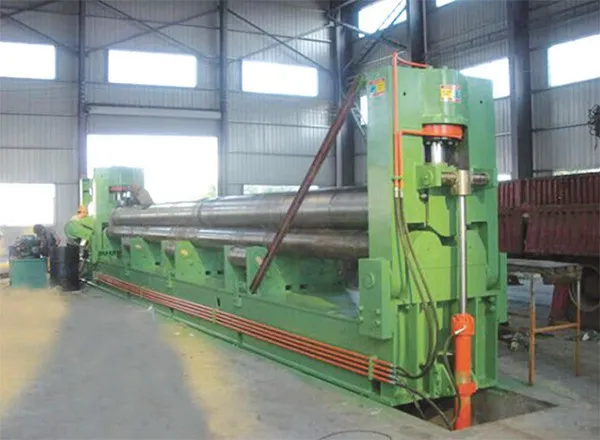
A three-roller plate bending machine is a highly versatile piece of equipment used in various industries for bending metal plates into different shapes, such as cylinders, cones, and arcs. It consists of three rollers - two lower rollers and one upper roller. The lower rollers rotate in the same direction, while the upper roller can move vertically to apply pressure on the plate, causing it to bend.
The Steel Plate Rolling Machine is a type of three - roller plate bending machine that is specifically designed for processing steel plates. It offers high precision and efficiency, making it a popular choice in the metalworking industry. The Automatic Plate Rolling Machine takes it a step further by incorporating advanced automation technology, which can significantly improve productivity and reduce labor costs.
Challenges of Bending Plates with Pre - Drilled Holes
When it comes to bending plates with pre - drilled holes, there are several challenges that need to be addressed.
Hole Deformation
One of the main concerns is the deformation of the pre - drilled holes. During the bending process, the plate is subjected to significant stress and strain. The material near the holes may experience uneven deformation, which can cause the holes to become oval - shaped or distorted. This can be a major issue, especially if the holes are used for precise alignment or connection purposes.
Stress Concentration
Pre - drilled holes can act as stress concentration points. When the plate is bent, the stress around the holes is much higher than in other areas of the plate. This can lead to cracking or even fracture of the plate, especially if the material is brittle or the bending radius is too small.
Alignment Issues
If the holes are used for alignment or assembly, bending the plate can cause misalignment. The relative positions of the holes may change during the bending process, which can make it difficult or impossible to assemble the parts correctly.
Factors Affecting the Feasibility
Despite these challenges, it is still possible to use a three - roller plate bending machine to bend plates with pre - drilled holes under certain conditions.
Hole Size and Spacing
The size and spacing of the holes play a crucial role. If the holes are relatively small and widely spaced, the impact on the bending process is likely to be less significant. On the other hand, large holes or closely spaced holes are more likely to cause deformation and stress concentration.
Material Properties
The properties of the plate material, such as its strength, ductility, and hardness, also affect the feasibility of bending plates with pre - drilled holes. Ductile materials, such as mild steel, are more likely to withstand the bending process without significant damage compared to brittle materials, such as cast iron.
Bending Radius
The bending radius is another important factor. A larger bending radius generally results in less stress and strain on the plate, reducing the risk of hole deformation and cracking. If the bending radius is too small, the stress around the holes can become excessive, leading to failure.
Solutions and Precautions
To overcome the challenges and ensure successful bending of plates with pre - drilled holes, several solutions and precautions can be taken.
Use of Special Tooling
The Special Shaped Roller Rack can be used to provide more uniform pressure on the plate during the bending process. This can help reduce the stress concentration around the holes and minimize deformation.
Pre - Treatment
Pre - treatment of the plate, such as annealing, can improve its ductility and reduce the risk of cracking. Annealing involves heating the plate to a specific temperature and then cooling it slowly, which can relieve internal stresses and make the material more malleable.
Hole Reinforcement
In some cases, reinforcing the holes can be an effective solution. This can be done by welding a ring or a sleeve around the holes to increase their strength and resistance to deformation.
Simulation and Testing
Before bending the actual plate, it is advisable to conduct simulations and tests. Computer - aided simulation can help predict the deformation and stress distribution of the plate during the bending process, allowing us to optimize the process parameters. Physical testing on sample plates can also provide valuable information and help us identify any potential issues.

Conclusion
In conclusion, a three - roller plate bending machine can be used to bend plates with pre - drilled holes, but it requires careful consideration of the factors mentioned above. By understanding the challenges, taking appropriate precautions, and using the right techniques and tooling, we can achieve successful bending results while minimizing the risk of damage to the holes and the plate.
If you are considering using a three - roller plate bending machine to bend plates with pre - drilled holes, or if you have any other questions about our products, please feel free to contact us for more information and professional advice. We are committed to providing high - quality equipment and excellent customer service to meet your specific needs.
References
- "Metal Forming Handbook: Processes and Applications" by Georg E. Dieter
- "Manufacturing Engineering and Technology" by S. Kalpakjian and S. R. Schmid


