

As a supplier of three-roller plate bending machines, I've been deeply involved in understanding the intricacies of these remarkable pieces of equipment. One of the most crucial aspects in the operation and design of a three-roller plate bending machine is the bending force prediction model. In this blog, I'll delve into what this model is, its significance, and how it impacts the performance of our Hydraulic Three-roller Plate Bending Machine and Three-roller Plate Bending Machine.
Understanding the Three - Roller Plate Bending Machine
Before we jump into the bending force prediction model, let's briefly understand the three-roller plate bending machine. This machine is used to bend metal plates into various shapes, such as cylinders, cones, or arcs. It consists of three rollers - two lower rollers and one upper roller. The lower rollers are usually driven, while the upper roller can be adjusted in height to control the bending radius of the plate. The machine is widely used in industries like shipbuilding, pressure vessel manufacturing, and construction, where precise bending of metal plates is required.
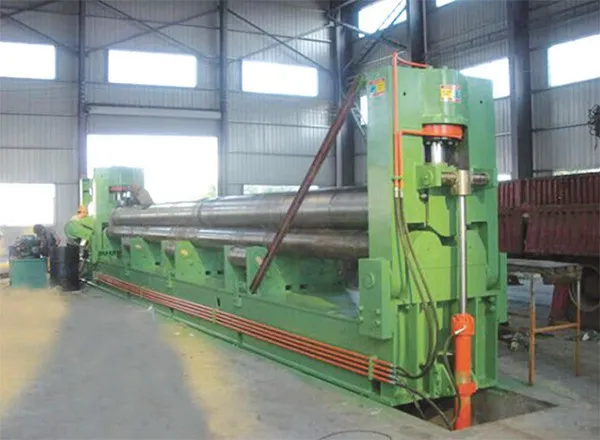

What is the Bending Force Prediction Model?
The bending force prediction model is a mathematical or empirical formula used to estimate the force required to bend a metal plate using a three-roller plate bending machine. This model takes into account several factors that influence the bending force, including the material properties of the plate, the thickness of the plate, the bending radius, and the width of the plate.
Factors Influencing the Bending Force
- Material Properties: Different metals have different mechanical properties, such as yield strength, tensile strength, and elasticity modulus. Metals with higher yield strength require more force to bend. For example, stainless steel has a higher yield strength compared to mild steel, so more force is needed to bend a stainless - steel plate of the same thickness and dimensions.
- Plate Thickness: The thicker the plate, the more force is required to bend it. This is because a thicker plate has more material to deform, and the internal stresses within the plate are higher during the bending process.
- Bending Radius: A smaller bending radius requires more force. When the plate is bent into a smaller radius, the outer fibers of the plate are stretched more, and the inner fibers are compressed more, resulting in higher internal stresses and thus a greater bending force.
- Plate Width: A wider plate generally requires more force to bend. As the width increases, the amount of material being bent also increases, leading to higher bending forces.
Mathematical and Empirical Models
There are several mathematical and empirical models available for predicting the bending force. One of the most commonly used empirical formulas is based on the theory of pure bending. The formula for the bending force (F) can be expressed as:
[F = k\frac{\sigma_{s}t^{2}L}{R}]
where (k) is a coefficient that depends on the bending process and the machine design, (\sigma_{s}) is the yield strength of the material, (t) is the thickness of the plate, (L) is the width of the plate, and (R) is the bending radius.
Another approach is to use finite element analysis (FEA) to simulate the bending process. FEA is a numerical method that divides the plate into small elements and analyzes the stress and strain distribution within each element. By solving the equations of equilibrium and material behavior for each element, the bending force can be accurately predicted. However, FEA requires more computational resources and time compared to empirical formulas.
Significance of the Bending Force Prediction Model
The bending force prediction model is of great significance for both the design and operation of three-roller plate bending machines.
Machine Design
- Roller and Frame Design: Knowing the maximum bending force helps in designing the rollers and the frame of the machine. The rollers need to be strong enough to withstand the bending force without excessive deformation. The frame also needs to be rigid enough to prevent any misalignment or deflection during the bending process.
- Selection of Drive System: The power of the drive system, such as the motors and gears, depends on the bending force. A more powerful drive system is required for machines that need to bend thick or high - strength plates.
Machine Operation
- Process Planning: The bending force prediction model helps in planning the bending process. Operators can determine whether the machine can handle a particular bending task based on the predicted bending force. If the predicted force exceeds the machine's capacity, appropriate measures can be taken, such as reducing the plate thickness or increasing the bending radius.
- Quality Control: Accurate prediction of the bending force ensures that the plate is bent to the desired shape and dimensions. If the bending force is too low, the plate may not be bent enough, while if the force is too high, the plate may be over - bent or damaged.
Our Experience as a Supplier
As a supplier of three-roller plate bending machines, we have extensive experience in dealing with the bending force prediction model. We use advanced software and engineering knowledge to optimize the design of our machines based on the predicted bending forces. Our Hydraulic Three-roller Plate Bending Machine and Three-roller Plate Bending Machine are designed to handle a wide range of plate thicknesses and materials, thanks to our accurate bending force prediction models.
We also provide our customers with technical support and guidance on using the bending force prediction model. Our engineers can help customers select the right machine for their specific applications and assist in process planning to ensure the best bending results.
Role of the Tank Shaped Roller Stand
In addition to the main three - roller plate bending machine, we also offer the Tank Shaped Roller Stand. This roller stand plays an important role in the bending process. It provides additional support to the plate during bending, especially for long or wide plates. By reducing the unsupported length of the plate, the roller stand helps to distribute the bending force more evenly, reducing the risk of plate deformation and improving the bending quality.
Conclusion
The bending force prediction model is an essential tool for the design and operation of three-roller plate bending machines. It allows us to accurately estimate the force required for bending metal plates, which in turn helps in optimizing the machine design, planning the bending process, and ensuring high - quality bending results.
As a supplier, we are committed to providing our customers with the best three - roller plate bending machines and related products, such as the Tank Shaped Roller Stand. If you are in the market for a three - roller plate bending machine or need more information about the bending force prediction model, we encourage you to contact us for a detailed discussion and procurement negotiation. Our team of experts is ready to assist you in finding the most suitable solution for your business needs.
References
- Bending Technology Handbook, [Publisher's Name], [Year of Publication]
- Finite Element Analysis of Metal Forming Processes, [Author's Name], [Publisher's Name], [Year of Publication]
- Machine Design for Metal Forming Processes, [Author's Name], [Publisher's Name], [Year of Publication]


