

Hey there! As a supplier of beam straightening machines, I've seen firsthand how crucial beam end conditions are in the straightening process. In this blog, I'm gonna break down what those end conditions are and how they impact the whole straightening deal.
First off, let's talk about what we mean by beam end conditions. Basically, it's how the ends of the beam are supported or constrained during the straightening process. There are a few common types of end conditions, and each one has its own unique effects on how the beam gets straightened.
One of the most common end conditions is the fixed - end condition. When the ends of the beam are fixed, it means they're held firmly in place so that they can't rotate or move in a linear direction. This is like having the beam's ends bolted down tight. In a fixed - end situation, the beam has a lot of resistance to bending. When you start the straightening process, the forces applied to the beam are distributed differently compared to other end conditions. The fixed ends create a sort of "anchoring" effect, which can be both good and bad.
On the plus side, because the ends are fixed, the straightening forces can be more precisely controlled. You can target specific areas of the beam for straightening without worrying too much about the ends moving around and throwing off the alignment. This is great for achieving a high - precision straightening result, especially for beams that need to meet very strict dimensional tolerances. For example, in the construction of high - rise buildings, where beams need to be perfectly straight to ensure the structural integrity of the whole building, a fixed - end condition during straightening can be a game - changer.
However, there are also some downsides. The fixed ends can cause high stress concentrations at the supports. If the straightening forces are too large, these stress concentrations can lead to local deformation or even cracking at the beam ends. This is a major concern because it can weaken the overall strength of the beam. So, when using a fixed - end condition, you've gotta be really careful about the amount and distribution of the straightening forces.
Another common end condition is the simply - supported end condition. In this case, the beam's ends are supported in a way that allows them to rotate freely but restricts linear movement in the vertical direction. It's like having the beam sitting on two rollers. The simply - supported end condition is more forgiving in terms of stress distribution compared to the fixed - end condition.
When straightening a beam with simply - supported ends, the bending moment distribution along the beam is different. The maximum bending moment occurs at the mid - span of the beam. This means that the straightening forces are mainly focused on the middle part of the beam to correct any curvature. It's a bit easier to predict and control the deformation of the beam in this end condition.
But there are drawbacks too. Since the ends can rotate, there's a risk that the beam might not be held in place as securely as with a fixed - end condition. This can lead to some inaccuracies in the straightening process, especially if the beam is subjected to external vibrations or other disturbances during straightening. Also, because the bending moment is concentrated at the mid - span, it might be more difficult to straighten beams with complex curvature patterns that involve multiple bends along their length.
Then there's the free - end condition. In a free - end condition, the beam's ends are completely unconstrained. This is a rare case in the beam straightening process because it's very difficult to control the straightening accurately. Without any support or constraint at the ends, the beam can move and deform in unpredictable ways when the straightening forces are applied.
However, in some special situations, like when dealing with very short beams or when performing some preliminary straightening operations, a free - end condition might be used. But you've really gotta be on your toes when using this condition. You need to have a very good understanding of the beam's material properties and the forces involved to avoid over - straightening or causing other unwanted deformations.
Now, let's talk about how these end conditions affect the choice of beam straightening machine. Different beam end conditions require different types of straightening machines or different settings on the same machine.
For fixed - end conditions, you need a machine that can apply precise and controlled forces. Hydraulic beam straightening machines are often a good choice because they can generate high forces with a high degree of accuracy. These machines can be adjusted to apply the right amount of force at the right locations along the beam to counteract the stress concentrations at the fixed ends.
When dealing with simply - supported end conditions, a mechanical beam straightening machine might be sufficient in many cases. These machines are usually more cost - effective and can provide a relatively straightforward way to apply the necessary bending forces at the mid - span of the beam.
For free - end conditions, you might need a more advanced and flexible straightening machine. Some modern computer - controlled beam straightening machines can be programmed to adapt to the unpredictable movements of the beam during straightening. These machines use sensors to monitor the beam's deformation in real - time and adjust the straightening forces accordingly.
As a beam straightening machine supplier, I also want to mention some of our other related products. We offer a range of intelligent tooling equipment that can complement the beam straightening process. For example, check out our H - type Girder Assembly Tooling. It's a great tool for assembling H - type girders with high precision, which is often required after the beams are straightened.
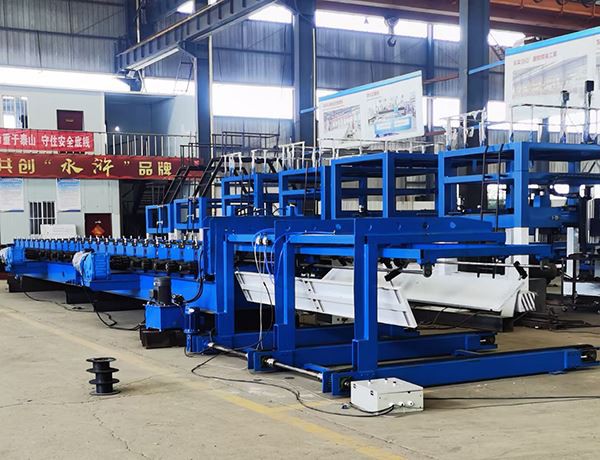
We also have the CNC Container Side Panel Pressing Machine and the CNC Container Roof Forming Machine. These machines are used in the container manufacturing industry, where straight beams are essential for the overall structure of the containers.
In conclusion, beam end conditions play a huge role in the beam straightening process. Understanding how each end condition affects the stress distribution, bending moment, and overall deformation of the beam is crucial for choosing the right straightening method and machine. Whether you're in the construction, manufacturing, or any other industry that uses beams, getting the straightening process right can save you a lot of time, money, and headaches in the long run.

If you're interested in learning more about our beam straightening machines or any of our other products, feel free to reach out to us. We're always happy to have a chat and discuss how we can meet your specific needs. Whether you've got a small - scale project or a large - scale industrial operation, we've got the solutions to help you get the job done right.
References
- "Mechanics of Materials" by Ferdinand P. Beer, E. Russell Johnston Jr., John T. DeWolf, and David F. Mazurek
- "Structural Analysis" by R. C. Hibbeler


