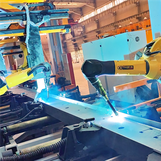
As a supplier of automatic welding machines, I often encounter customers who are curious about how these machines adjust welding parameters. In this blog post, I'll delve into the intricacies of parameter adjustment in automatic welding machines, sharing insights based on our extensive experience in the industry.
Understanding Welding Parameters
Before we explore how automatic welding machines adjust parameters, it's crucial to understand what these parameters are. Welding parameters include variables such as welding current, voltage, welding speed, wire feed speed, and gas flow rate. Each of these parameters plays a vital role in determining the quality and efficiency of the welding process.
- Welding Current: This is the amount of electrical current flowing through the welding arc. It directly affects the heat input and penetration of the weld. Higher current generally results in deeper penetration but may also lead to excessive spatter and distortion.
- Voltage: Voltage controls the length and stability of the welding arc. A proper voltage setting ensures a smooth and consistent arc, which is essential for producing high - quality welds. Incorrect voltage can cause issues like arc instability, uneven bead formation, and poor fusion.
- Welding Speed: The speed at which the welding torch moves along the joint affects the bead shape, penetration, and overall productivity. Too slow a speed can lead to excessive heat input and distortion, while too fast a speed may result in incomplete fusion.
- Wire Feed Speed: In wire - fed welding processes, the wire feed speed determines the amount of filler metal being deposited into the weld. It needs to be coordinated with the welding current and voltage to achieve optimal results.
- Gas Flow Rate: For processes that use shielding gas, such as MIG and TIG welding, the gas flow rate is critical. It protects the weld pool from atmospheric contamination, preventing defects like porosity and oxidation.
Manual vs. Automatic Parameter Adjustment
In traditional welding, operators manually adjust the welding parameters based on their experience and the requirements of the specific job. This approach requires skilled welders who can make real - time adjustments to ensure consistent weld quality. However, it also has limitations, such as human error and the inability to maintain precise settings over long periods.
Automatic welding machines, on the other hand, offer a more precise and efficient way of adjusting welding parameters. These machines are equipped with advanced control systems that can automatically adjust the parameters based on pre - programmed settings or feedback from sensors.
How Automatic Welding Machines Adjust Parameters
Pre - Programming
One of the primary ways automatic welding machines adjust parameters is through pre - programming. Before starting the welding process, operators can input the desired welding parameters into the machine's control system. These parameters are then stored in the machine's memory and can be recalled for future use.
For example, if a manufacturer needs to weld a specific type of joint on a regular basis, they can program the optimal welding current, voltage, and speed for that joint. The machine will then automatically adjust these parameters during the welding process, ensuring consistent and high - quality welds.


Sensor - Based Adjustment
Many modern automatic welding machines are equipped with sensors that can monitor various aspects of the welding process in real - time. These sensors can detect changes in parameters such as arc length, temperature, and wire feed rate, and send feedback to the control system.
The control system can then make automatic adjustments to the welding parameters to compensate for these changes. For instance, if the sensor detects a decrease in arc length, the control system can increase the voltage to maintain a stable arc.
Adaptive Control
Some advanced automatic welding machines feature adaptive control systems. These systems can analyze the welding process and adjust the parameters based on the actual conditions of the joint. For example, if the joint has irregularities or variations in thickness, the adaptive control system can automatically adjust the welding current and speed to ensure proper fusion.
Parameter Adjustment in Different Types of Automatic Welding Machines
Cantilever Circular Seam Welding Machine
This type of machine is designed for welding circular seams. When adjusting the parameters, factors such as the diameter of the workpiece, the thickness of the material, and the type of joint need to be considered. For example, for a larger - diameter workpiece, a lower welding speed may be required to ensure proper heat distribution. The control system of the cantilever circular seam welding machine can be pre - programmed to adjust the welding current, voltage, and speed based on these factors.
Beam Robot Welding Workstation
Beam robot welding workstations are highly flexible and can be used for a variety of welding tasks. These workstations are equipped with robotic arms that can move the welding torch in multiple directions. The control system of the beam robot welding workstation can adjust the welding parameters based on the path and orientation of the robotic arm. For example, when the arm is moving at a high speed, the welding current and voltage may need to be adjusted to maintain a stable arc.
Corrugated Board Automatic Welding Machine
Corrugated board automatic welding machines are specifically designed for welding corrugated boards. The unique shape and structure of corrugated boards require precise parameter adjustment. The machine's control system can adjust the welding parameters to ensure proper fusion at the peaks and valleys of the corrugations. For example, the welding speed may need to be adjusted to account for the changes in the distance between the welding torch and the workpiece.
Importance of Correct Parameter Adjustment
Correct parameter adjustment is crucial for achieving high - quality welds. Incorrect parameters can lead to a variety of welding defects, such as porosity, lack of fusion, and excessive spatter. These defects can weaken the weld joint and reduce the overall strength and durability of the welded structure.
In addition, proper parameter adjustment can also improve productivity and reduce costs. By optimizing the welding parameters, the machine can operate more efficiently, reducing the time and materials required for each weld.
Conclusion
Automatic welding machines offer a precise and efficient way of adjusting welding parameters. Through pre - programming, sensor - based adjustment, and adaptive control, these machines can ensure consistent and high - quality welds. As a supplier of automatic welding machines, we are committed to providing our customers with the latest technology and support to help them achieve the best possible welding results.
If you are interested in learning more about our automatic welding machines or have any questions about parameter adjustment, please feel free to contact us for a procurement discussion. We look forward to working with you to meet your welding needs.
References
- Welding Handbook, American Welding Society
- Principles of Welding, McGraw - Hill Education