

As a provider of welding robot workstations, I understand the importance of properly adjusting the parameters of these systems to achieve optimal performance and high - quality welds. In this blog post, I'll share some in - depth knowledge on how to adjust the parameters of a welding robot workstation.
Understanding the Basics of Welding Robot Workstation Parameters
Before diving into the adjustment process, it's crucial to understand the key parameters involved in a welding robot workstation. These parameters can be broadly classified into three main categories: welding process parameters, robot motion parameters, and system - related parameters.
Welding Process Parameters
Welding process parameters are directly related to the welding operation itself. They include welding current, voltage, welding speed, wire feed speed, and gas flow rate.
- Welding Current: This is one of the most critical parameters. A higher welding current generally results in deeper penetration but may also cause excessive spatter and over - heating. On the other hand, a lower current may lead to insufficient penetration. The optimal welding current depends on the thickness of the workpiece, the type of welding wire, and the welding position.
- Voltage: Voltage affects the arc length and the shape of the weld bead. A higher voltage increases the arc length, which can lead to a wider and flatter weld bead. However, if the voltage is too high, the arc may become unstable. Conversely, a lower voltage shortens the arc length and produces a narrower and taller weld bead.
- Welding Speed: The speed at which the welding torch moves along the joint affects the heat input and the appearance of the weld. A faster welding speed reduces the heat input per unit length, resulting in a smaller heat - affected zone. But if the speed is too high, the weld may be incomplete or have poor fusion.
- Wire Feed Speed: This parameter is closely related to the welding current. A higher wire feed speed increases the amount of filler metal deposited and generally corresponds to a higher welding current. It's essential to maintain a proper balance between the wire feed speed and the welding current to ensure a stable arc and good weld quality.
- Gas Flow Rate: For gas - shielded welding processes, the gas flow rate is crucial for protecting the weld pool from atmospheric contamination. Insufficient gas flow may lead to porosity in the weld, while excessive flow can cause turbulence and disrupt the arc.
Robot Motion Parameters
Robot motion parameters control the movement of the welding robot. They include the path of the robot arm, the speed of movement, and the orientation of the welding torch.
- Path Planning: The robot's path should be carefully planned to ensure that the welding torch follows the joint accurately. This may involve programming the robot to move in straight lines, arcs, or complex curves. The path should also take into account any obstacles or fixtures in the workstation.
- Motion Speed: The speed of the robot arm affects the overall productivity of the welding process. However, it's important to ensure that the motion speed is compatible with the welding speed to maintain a consistent weld quality.
- Torch Orientation: The orientation of the welding torch relative to the workpiece affects the weld bead shape and the penetration. The torch angle and tilt should be adjusted according to the welding position and the joint design.
System - related Parameters
System - related parameters include things like the type of welding power source, the communication settings between the robot and the power source, and the calibration of sensors.
- Welding Power Source: Different types of welding power sources, such as constant - current or constant - voltage sources, have different characteristics and require different parameter settings. It's important to select the appropriate power source for the welding process and adjust its parameters accordingly.
- Communication Settings: The robot and the welding power source need to communicate effectively to ensure coordinated operation. Incorrect communication settings can lead to problems such as inconsistent welding parameters or even system failures.
- Sensor Calibration: Many welding robot workstations are equipped with sensors for tasks such as seam tracking and position sensing. Proper calibration of these sensors is essential for accurate welding.
Adjusting the Parameters
Now that we understand the key parameters, let's discuss the process of adjusting them.
Step 1: Initial Setup
Before starting the parameter adjustment, it's important to perform a thorough initial setup of the welding robot workstation. This includes installing the appropriate welding torch, loading the correct welding wire, and setting up the gas supply. Make sure all the mechanical components of the robot are properly aligned and lubricated.
Step 2: Workpiece Preparation
Prepare the workpiece by cleaning the joint area to remove any dirt, rust, or oil. This ensures good electrical contact and proper fusion during welding. Measure the thickness of the workpiece accurately, as this information is crucial for determining the initial welding parameters.
Step 3: Initial Parameter Selection
Based on the type of welding process, the thickness of the workpiece, and the welding position, select some initial parameter values. You can refer to welding manuals, manufacturer's recommendations, or past experience for this purpose. For example, if you're welding a 3 - mm thick mild steel plate using gas - metal arc welding (GMAW), you might start with a welding current of around 120 - 150 A, a voltage of 20 - 22 V, a welding speed of 30 - 40 cm/min, a wire feed speed of 4 - 5 m/min, and a gas flow rate of 15 - 20 L/min.
Step 4: Test Welding
Perform a test weld on a sample workpiece using the initial parameter settings. Observe the appearance of the weld bead, check for any signs of defects such as porosity, cracks, or lack of fusion, and measure the dimensions of the weld bead. You can also use non - destructive testing methods, such as ultrasonic testing or X - ray testing, to evaluate the internal quality of the weld.
Step 5: Parameter Adjustment
Based on the results of the test weld, make adjustments to the parameters. If the weld bead is too wide, you might decrease the voltage or increase the welding speed. If there is excessive spatter, you could try adjusting the welding current or the wire feed speed. It's important to make small adjustments at a time and repeat the test welding until you achieve the desired weld quality.
Step 6: Fine - Tuning
Once you've achieved a satisfactory weld quality on the sample workpiece, perform a few more test welds on different parts of the workpiece or on similar workpieces to ensure consistency. Make any final fine - tuning adjustments to the parameters as needed.
Utilizing Advanced Tools and Technologies
In addition to the traditional method of manual parameter adjustment, there are several advanced tools and technologies that can help optimize the parameter settings of a welding robot workstation.
- Welding Process Simulation Software: This software allows you to simulate the welding process before actually performing the weld. You can input the workpiece geometry, the welding parameters, and other relevant information, and the software will predict the weld bead shape, the heat - affected zone, and the residual stress distribution. This helps you to identify potential problems and optimize the parameters in a virtual environment.
- Real - Time Monitoring Systems: Some modern welding robot workstations are equipped with real - time monitoring systems that can measure various parameters such as welding current, voltage, and arc stability during the welding process. These systems can provide feedback to the operator or automatically adjust the parameters to maintain a stable and high - quality weld.
Conclusion
Adjusting the parameters of a welding robot workstation is a complex but essential task for achieving high - quality welds and maximizing productivity. By understanding the key parameters, following a systematic adjustment process, and utilizing advanced tools and technologies, you can optimize the performance of your welding robot workstation.
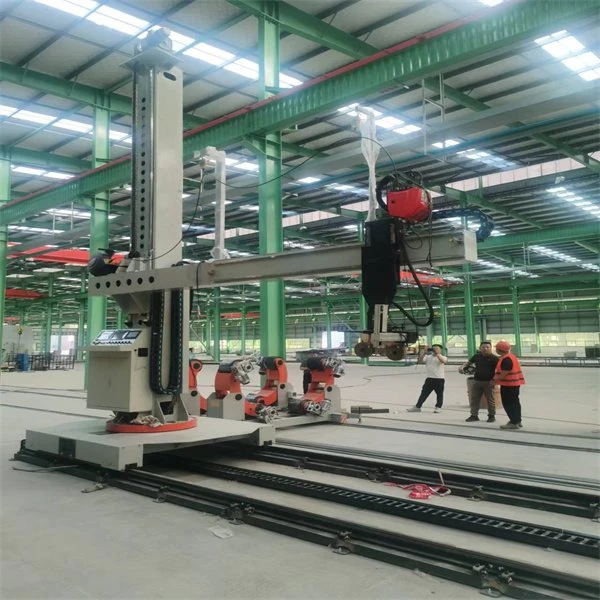
If you're in the market for a welding robot workstation or need further assistance with parameter adjustment, we're here to help. Our company offers a wide range of high - quality welding equipment, including the Automatic Tank Girth Welding Machine, Laser Automatic Welding Machine, and Automatic Laser Welding Machine. Contact us today to discuss your specific requirements and start a procurement negotiation.

References
- AWS Welding Handbook, American Welding Society.
- Welding Technology: Principles and Applications, John C. Foulke.
- Robotics for Manufacturing: Fundamental Concepts, Byung - Rae Cho.


